Showing posts with label CS. Show all posts
Showing posts with label CS. Show all posts
Tuesday, April 12, 2011
Not Going to College May Be Better Than Using a Credit Card?
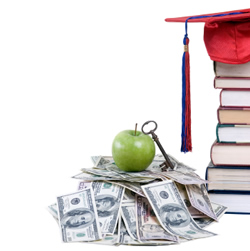
I will be going to college next year and I have to worry about paying off loans that I will take on in order to pay for my tuition for at least four years of my college education, and, most likely, four, or more, years of college education after that. This would not worry as much if I did not know about this surprising statistic that student loan debt has now surpassed credit card loan debt. The amount of money for college tuition has grown so much in the last few years that now . It may be taking it too far by saying that not going to college may be a better decision than not using a credit card, but this certainly shows us the troubling circumstances in today's America. On top of the increasingly greater education required for getting a job, the tuition for the education and the costs for college is also increasing.

Cuts to Education Despite Obama's Words
The budget for 2011-2012 has been a heated issue for both Republicans and Democrats. The United States came close to its second government shutdown because the two parties had been unable to decide on a budget that would suit them both. Today, April 12, 2011, the Republicans gave in to some of the demands of the Democrats instead of stubbornly pushing for their own way, an attitude that has been recently exhibited by the Democrats. In an earlier post, I explained how President Obama had declared cuts to education for the next budget as something he will not allow because cutting from the education portion of the budget would be cutting from the future of America and cutting possibly an expansion of the economy. According to Ben Wolfgang of the Washington Times in his article titled "Education cuts coming, but fewer than GOP wanted," the two parties finally agreed on a budget, but there were some cuts to education, despite Obama's declaration that education is untouchable for the 2011-2012 budget:
The final spending deal struck by the White House and congressional leaders spares the Education Department the deeper cuts sought by House Republicans, according to the agreement reached Friday. Under the compromise - the details of which started trickling out late Monday night - the popular Pell Grant and pre-kindergarten Head Start programs are preserved, as is funding for the administration’s Race to the Top initiative.Both parties had to come to some sort of a compromise, with the Republicans getting fewer cuts to the budget, particularly the education portion of the budget, and with the Democrats having to deal with more cuts than they wanted to the education portion of the budget.
Other Education Department programs weren’t so lucky, with funding reduced for about two dozen programs, though many of the multimillion-dollar cuts already had been proposed by President Obama in his 2011 spending plan.

Obama Attacks Inequalities in Education
Partially in an early attempt to seek votes for his reelection in 2012 and partially as a minority himself, President Barack Obama spoke about inequalities in education and to inspire more and greater achievements by African-Americans and other minority parties at the 20th anniversary Reverend Al Sharpton's National Action Network. Helene Cooper highlights the important points of the president's speech in her article in the New York Times entitled "Obama Takes Aim at Inequality in Education."

“Too many of our kids are dropping out of schools,” Mr. Obama told a mostly black audience in the ballroom of the Sheraton New York Hotel in Manhattan. “That’s not a white, black or brown problem. That’s everybody’s problem.”Despite what he said, Obama's speech at the event was primarily focused on gathering and unifying his African-American base for his reelection campaign for 2012. African-Americans represent a large portion of the country's population, and Obama needs to get back in touch with them in order to garner their support. Obama also emphasized education and achievement in his speech in order to establish that he wants to equalize the generally African-American graduation rates with those of other populations of people in America who tend to have higher graduation, success and achievement rates.

Cell Phones Disrupting Education
The article in the San Francisco Chronicle titled "Bangladesh to teachers: No cellphones in classroom" explains yet another instance of technology, cell phones specifically, disturbing education:
 The use of cell phones for students had already been taken away for schools in Bangladesh, but that was not enough to eliminate cell phone disturbances in classrooms. Teachers were found spending time on their cell phones now, and they had to ban the use completely in the classrooms. Even though technology can and is of great use in the classroom for teaching purposes, there must be a limit as to how much and when the technology is used. Cell phones provide little to no productive use in the classrooms and banning them in all classrooms would definitely improve education. We are still grappling with how to productively and beneficially intertwine technology, with all of its uses, into classroom learning, but once we do, education will become very effective and easy.
Fed up with educators receiving — and even making — phone calls during their own lectures, Bangladesh's Education Ministry has banned them from bringing their phones into class as well.
 The use of cell phones for students had already been taken away for schools in Bangladesh, but that was not enough to eliminate cell phone disturbances in classrooms. Teachers were found spending time on their cell phones now, and they had to ban the use completely in the classrooms. Even though technology can and is of great use in the classroom for teaching purposes, there must be a limit as to how much and when the technology is used. Cell phones provide little to no productive use in the classrooms and banning them in all classrooms would definitely improve education. We are still grappling with how to productively and beneficially intertwine technology, with all of its uses, into classroom learning, but once we do, education will become very effective and easy.
Education in America: An Institution in Need of Remodel
Part I:
According to the standards set by former President George W. Bush in his “No Child Left Behind” policy, approximately eighty-two percent of United States schools will be considered failing by the next school year in 2011 (Armario). Education lays the foundation for any consistent, exceptional country because no country can run well or smoothly with an ignorant population base that is unable to grasp any of the concepts or issues of the world. As cliché as it may sound, education is the key to the future; it unlocks a whole new world of higher thinking, and it demands respect. An educated population is able to make educated and responsible decisions that will benefit the country both in the present and in the future. Education is a part of America that is in need of improvement and/or reform. In an attempt to improve education 8 years ago, former President George W. Bush implemented his “No Child Left Behind” policy. This policy was a good step forward, but has its flaws, and these flaws are among some of the problems that must be addressed with respect to education. The policy puts emphasis on test scores to a ridiculous extent and does little to prepare students for “the real world.” In addition, the policy puts stress on children below the standards to perform better, yet does not inspire well-performing children to do better (“No Child Left Behind”). In this respect, it is a somewhat one-sided educational initiative because it does not build a much better, overall well-informed and well-educated population.
It is obvious that education is a pressing issue in today’s America and it is clear that the American education system is in serious need of reform not only because we are terribly far from meeting our own standards, but also because America is continuously falling behind and losing speed in terms of world standing and in terms of its economy. China has already pushed its way past the United States to figuratively gain the number one spot in the world and there is no doubt that other countries, such as India, are on the rise and are also pushing past America. While I do not believe that education is the reason behind America’s current fall in standing and its stagnant economy, it was one of the issues facing America for several years that was set aside untreated and left to deteriorate and, in effect, sink the ship that is the United States, with help from other critical issues America has been dealing with for years. In 2006, shortly before the American economy began its sharp downturn and while China was a country rising to the top, Hong Kong, essentially its own country within the larger country of China, had overwhelmingly high math and science literacy rates, both by over ten percent, and had over four percent better language skills. As of 2006, there were also at least twenty countries, including Hong Kong, with overall smarter, better educated children and I doubt that that number has decreased in the last few years (Lubin). Even though the United States is confronting many other issues that are of seemingly greater significance than education and even though, U.S. education is a critical topic that must be addressed because it is an issue that will benefit the U.S. in both the short-term and the long-term, as well as establish a more sophisticated and knowledgeable American population that will be able to make better decisions.
Currently, education reform or simple education improvement is a farfetched idea. With the economy mightily struggling, few people are willing to give up any extra portion of their continuously decreasing salaries in taxes in order to pay for improvements and enhancements in the educational system and its components. Significant spending is more or less the only means by which education may be noticeably improved, and, considering the economy, any additional spending is unlikely. A large portion of the Republican Party is also unwilling to pay any higher taxes in general, and are especially unwilling in the recession that America is facing presently, therefore, any type of vast changes or improvements in education are doubtful. In referring to the Republican Party, I am alluding to not only Republican leaders across the country, but also the Republican population of the nation. Additionally, people who are falling short in terms of money, a population of people which is considerably large and is frequently increasing, vehemently reject any sort of tax or additional costs that will detract from their paychecks. Recently, President Barack Obama declared, during the 2011 budget talks, that “even as we find ways to cut spending we cannot cut back on job-creating investments like education. We cannot cut back on the very investments that will help our economy grow” (Johnston). Obama is definitively setting his foot down to protect the education budget in order to protect the level of education of the future leaders of the United States.
Part II:
Former President George W. Bush and current president, Barack Obama have taken some steps in order to help alleviate the problems in American education in the last decade. In a very bold and far-ranging move, Bush introduced a new education initiative called “No Child Left Behind.” This policy, in essence, aimed to provide incentive for federally funded schools to perform better by promising greater funding to the schools with low education rankings whose students performed well on standardized tests. Standardized tests were to be administered from third through eighth grades and in at least one year of high school “with the goal of making every U.S.student proficient (performing at grade level) in reading and math by 2014” (“No Child Left Behind”). This program was a large part of Bush’s campaign as well as one of the biggest productions of his presidency and it unquestionably established a sort of precedent in education that was to be followed by President Barack Obama. While in the first year or so of his presidency, Obama concentrated on issues that were focused much more towards restoring America and bringing the country back into its own from the recession it had dipped into over the last several years, he has recently been taking steps to demonstrate his personal stand on American education. Notably, Obama declared the education portion of the budget untouchable, and for good reason. He said that education provides the foundation for the future of our country and will instigate future U.S. economic competitiveness and is one of the keys to finding our way out of this economic hole (Johnston). Additionally, the Obama Administration implemented a new program, entitled “Race to the Top,” designed to boost college graduation rates ("Obama Administration Education Policy”). Obama and Secretary of Education Arne Duncan have, together, set a goal of adding eight million college graduates by 2020 through offering grants to enhance college graduation rates (Lewin). Through this and other small expansions in the American educational system, President Obama has slightly altered and improved aspects of Bush’s initiative that were rough and undeveloped. In addition, in Obama’s “Race to the Top” policy, he has made it clear that teachers with low performing students should be replaced, even those who have extensive tenures and that principals and people who overlook schools should be replaced if their school’s students are not performing well. To contribute to Obama’s education improvements, the Bill and Melinda Gates Foundation is helping and has “helped subsidize states' applications for Race to the Top funds” ("Obama Administration Education Policy”).
Starting in 1999, the state of California implemented a new addition to the state educational procedure with the CAHSEE (California High School Exit Exam) to test that students were at grade level in writing, reading and mathematics. I took this test at Acalanes my sophomore year and I passed on my first attempt. Most people take it and pass it their first time during sophomore year, but if not, they are given another chance the same year, “two more chances in their junior year, two more in their senior year and at least one more chance after their senior year” ("Standardized High School Exit Exams”). These exit exams have stimulated greater academic achievement in California because they increase the value of the diploma and ensure that students have the necessary skills to succeed in the future, in college and in the workplace. The CAHSEE also ensures that new immigrants are not forced into the workplace with limited reading and writing skills and an overall limited education, therefore providing for a better educated and better performing population ("Standardized High School Exit Exams”).
Even though we have not studied education specifically in Government or Economics this year, we have dipped into the topic of education in America briefly from time to time. Thomas Friedman is the author of the book Hot, Flat, and Crowded, which details America’s current situation, the dip in the American economy, and why we are in our unfortunate current situation. Part of Friedman’s argument in the book is that the world is getting flat, or evening out, because of the explosion of a world on the web, but I contribute part of this flattening of the world, as he mentions, to recent American laziness. Friedman argues that “America’s problem is that it has lost its way in recent years…partly because of the bad habits that we have let build up over the last three decades…that have weakened our society’s ability and willingness to take on big challenges” (Friedman 5). According to Friedman, large issues, education in particular, have been left to deteriorate due to the inability and unwillingness U.S. leaders itself has fostered among its own people while America has been enjoying its spot at the top. Friedman also asserts that “the prevailing attitude on so many key issues in Washington today is ‘We’ll get to it when we feel like getting to it and it will never catch up to us, because we’re America’” (Friedman 8). Friedman, in effect, is saying that America has taken on an attitude of arrogance, laziness and has developed a feeling of imperviousness, and exhibits, as he puts it, an attitude of “dumb as we wanna be.” These attitudes are precisely the reason that America is quickly falling from the top and that education has gone south in the last several years. This unhealthy attitude must be quickly changed, or society will suffer, and the economy will improve very little, if at all.
Part III:
In spite of the progress and the measures taken to upgrade education in the United States by the last two presidents in the recent decade, there remain numerous issues, both small and large, in the educational system currently that must be tackled. Obama has taken some of the rough edges of Bush’s “No Child Left Behind” policy and smoothed them out or added on to the policy:
With the Race to the Top, Obama has stiffened Bush's mandates, requiring states to put specific policies in place (such as firing tenured teachers whose students' test scores are low) before the schools can compete for federal funds. Through this approach, Obama is achieving Bush's desired changes without any guarantee that states will be funded. These mandates are the most intrusive federal education policies ever imposed on public schools (Stephens).
While Obama has taken several steps in his own education policy such as the ones described above, the American education system still needs improvements in many aspects in order to fully improve and reach the next level. For example, both Bush and Obama did little for the middle- to high-performing schools across the nation. Both presidents’ policies have been focused close to entirely around bringing poor-performing schools up to par, without advancing the American educational system as a whole. I expect to see some expansions in education involving the schools that are in the middle area with respect to quality of education during the rest of Obama’s current presidential term and in his possible next presidential term. Because the “No Child Left Behind” policy is still in effect today, some of its problems that Obama has yet to fix still exist. The policy relies heavily on standardized tests, an issue that the majority of critics of the policy focus on. Standardized tests not only restrict the amount of real world teaching and preparation that may be done in schools, but they are also very ineffective ways of measuring learning in students. Learning is measured by how much students have been taught, not by specific standards that students are expected to meet, and the standardized tests ignore this. The standardized testing program as a means of evaluating student, teacher and school performance must either be altered drastically in order to measure learning better, or must be replaced by another means of evaluating educational performance.
Through my work with BuildOn, I feel that I have grasped a more real sense of the world and the issues that America, as well as the rest of the world, faces today. I have realized how necessary education is across the globe and how much it is lacking in a countless number of places. As a member of the BuildOn club, I have personally contributed significantly to buying supplies for building at least two schools in Nicaragua. In addition, I have provided the means by which prisoners in American prisons can educate themselves and improve their own language skills while they are spending time in prison, and I feel great about that. This year alone, I have helped raise nearly one thousand dollars with the BuildOn club in order to expand education in the world. I now realize how many issues there are in the world and how lacking our world is in almost every aspect. I feel that education is one of the most important matters that must be expanded because it leads to both the advancement of the human race, and it creates awareness among the entire educated population and inspires compassion, therefore channeling a desire to help with other enormous issues, such as poverty. Unfortunately, I have also become conscious of the fact that none of the substantial concerns in America and the world may ever be solved, which has brought me a slight feeling of hopelessness, but I have never been one to give up because I lost a little hope Just like with poverty, there is no way to resolve education problems because there will always be a certain issues that will continue to come up or matters that are difficult to fix, and, on top of that, education is something that can always be improved because nobody has or can have “too much” education.. I will continue to do community service throughout my life because I feel it will contribute to me as a person, and it will help at least one or more people in the world who are almost dying for the help.
Wednesday, March 23, 2011
Time for CSU's to Get Their Act Together
 Everyone knows that the economy of the state of California is one of the largest economies in the entire world. Everyone also knows that the California's economy, and more largely that of the United States, is very close to its lowest point ever. Part of this economic failure is due to bad practices, and some of it is simply due to bad luck. The bad practices probably have more weight for you if you're not into the whole "luck" thing (which I can understand because I am not very into it either), but regardless, California is in a hole, and needs to change those bad practices into good ones. The California State University system is in shady territory currently because of a "commingling of public and private funds," as Nanette Asimov states in her San Francisco Chronicle article entitled "CSU audit suggests better accounting on foundations." Asimov also explains that:
California State University should fix sloppy accounting practices that have led to confusion about which funds are public or private, says a new internal review of the $1.2 billion managed by more than 90 campus foundations and private enterprises on CSU property.
To be completely honest, parts of this article are entirely over my head, yet I can understand the gist of it, and I understand that the CSU's should not be so careless with their accounting. Dealing with cuts in their budget should be the main issue that they are dealing with, they shouldn't be dealing with their own "sloppy accounting practices." This misstep exemplifies the laziness and carelessness that America has exhibited lately, which is possibly one of the bigger contributors to its economic failures.
Duncan and Obama Double-Team Issues in Education
During a news briefing Monday, Secretary of Education Arne Duncan said the program, to be formally announced Tuesday by Vice President Joseph R. Biden Jr., would include only incentives — no “sticks” — for reforms aimed at helping the administration meet its goal of adding eight million college graduates by 2020...In addition, as part of its 2012 budget, the administration has proposed the $123 million “First in the World” initiative for programs that hold down tuition, increase completion rates and move students through college faster. Last, the $50 million College Completion Incentive Grants would reward states and schools for reforms that produce more college graduates.This move will definitely serve Americans, as well as the country as a whole by stimulating the economy through having a more educated workforce and by adding money to states that succeed in improving their number of college graduates. Hopefully this move will motivate states like Arkansas, Nevada and New Mexico to improve the education of their citizens, only 28% of which currently have college degrees.
E-Waste
This Saturday and Sunday, from 9-3 both days, Acalanes High School will be host to an electronics recycling event, called E-Waste. Acalanes has been a part of E-Waste for the past two years As the Fundraising Officer for BuildOn, I wanted to set up this event, partly because I wanted to continue this BuildOn, Acalanes, and Lafayette tradition, and partly because this event usually brings in a significant amount of money in fundraising for our club. By setting this event up through BuildOn, our club is able to make a percentage of the profits from the recycled goods that people bring in, in addition to receiving donations from people recycling their used electronics who come through the Acalanes parking lot.This event was somewhat of a hassle to set up, but as long as we get people constantly driving in, then I know we will be able to make a substantial amount of money close to what we made last year. I will be spending at least six of my weekend hours, three on Saturday and three on Sunday, to this event.
 While it may seem tempting, the money we fund-raise never goes to use for the club's operations; all the money always goes to purchasing supplies for the Trek trips that will now be available every season of the year except fall. These Trek trips are what BuildOn members and supervisors live for because going to a developing country and helping build a school there is an incredibly fun and memorable experience because you know that you are making a difference and you are having fun at the same time. Unfortunately, I don't think I'll be able to go on one of BuildOn's Trek trips because, even though a trip is offered this summer and graduated seniors are allowed to come, it does not look like our club will have the proper fundraising necessary ($5,000 for two people) in order to support a trip this year. With the expansion of BuildOn to colleges across the country, hopefully I will be able to continue my involvement with the organization and be able to possibly attend a Trek For Knowledge.
 While it may seem tempting, the money we fund-raise never goes to use for the club's operations; all the money always goes to purchasing supplies for the Trek trips that will now be available every season of the year except fall. These Trek trips are what BuildOn members and supervisors live for because going to a developing country and helping build a school there is an incredibly fun and memorable experience because you know that you are making a difference and you are having fun at the same time. Unfortunately, I don't think I'll be able to go on one of BuildOn's Trek trips because, even though a trip is offered this summer and graduated seniors are allowed to come, it does not look like our club will have the proper fundraising necessary ($5,000 for two people) in order to support a trip this year. With the expansion of BuildOn to colleges across the country, hopefully I will be able to continue my involvement with the organization and be able to possibly attend a Trek For Knowledge.
Wednesday, March 9, 2011
Don't Touch the Education Budget!

Obama has made education a centerpiece of his agenda to bolster U.S. economic competitiveness. Amid a debate with Republican lawmakers over how to trim the $3.7 trillion budget, the president is proposing to shift money from other departments and programs in order to provide more money to fund his education priorities. Among these are increasing the number of science, technology and mathematics teachers and producing an additional 8 million college graduates by 2020.Rather than looking for a quick-fix to boost the economy, the president is looking towards the future, looking to build the start of a generation of American schoolchildren who are smarter, more efficient and more proficient than the generation before them. He is unwilling to cut spending because he sees that education truly should be the centerpiece of any presidential agenda because it is one of the centerpieces of a strong nation.
No Child Left Behind?
Former president George W. Bush set up the No Child Left Behind policy which is now either making the students of America look completely incompetent, or making the policy look ridiculous, or a little of both. Even though President Obama will not have a chance to reform education within the span of the rest of his current term, America's education policy does need reform in the near future if we, as a country are to maintain our status as a superior nation. Christine Armario, in her article on March 9, 2011 entitled "82 percent of US schools may be labeled 'failing'" in the San Francisco Chronicle, explains that:
 Simply raising the standards for U.S. children is not going to make the children work harder, or be smarter, or test better. Education Secretary Arne Duncan believes that the No Child Left Behind policy is sorely undeveloped in its current state, and if nationwide education is to be improved, a few more, possibly significant changes will be required as a whole and in Bush's policy. The education system, the way teachers teach, the credentials teachers must have, and things of that nature must be modified, rather than taking the easy route of improving education by raising standards. Raising the standards might give some children less incentive to work harder because they know that they're already below standards, so it can't be the only method of attempting to raise test scores. This policy must be combined with another significant change in education in order for American schoolchildren to actually start to get smarter.
The Department of Education estimates the percentage of schools not meeting yearly targets for their students' proficiency in in math and reading could jump from 37 to 82 percent as states raise standards in attempts to satisfy the law's mandates.

Recent Community Work
 On Saturday, March 5, 2011, I attended the BuildOn Regional Service Project. For this project, BuildOn members from the East Bay all came and set up and worked at an event for kids in Richmond at the Richmond Public Library. I was in Richmond from 11 am to 4 pm for this project but we didn't begin the work until after we did a few icebreaker activities to get to know and talk to some of our fellow BuildOn members from different schools of the East Bay. After the icebreaker activities we got free lunch which was burritos with chips and salsa and it was delicious. After lunch, we got to work setting up the small fair in the courtyard of the Richmond Public Library. The job of my group was to set up a booth to give passports to kids for the fair so that they could get stamps after each activity they completed on the passport. With four stamps for four completed activities, the kids would get a raffle ticket. With the raffle ticket they would get a chance to win a copy of the book Richmond Tales by author Summer Brenner, who was also a guest at the event, reading her book. If they got more than four stamps then they would get another raffle ticket and they would receive a free used book that was provided by BuildOn and people from the community who donated their used books. The fair was very popular among the kids and I had a lot of fun myself just welcoming the kids to the fair. I did this same project last year and it was very fun last year too. My favorite part of this community service project was being able to have fun and play with the kids who constantly flowed in. I joined in a few games of musical chairs and other activities that other BuildOn members had set up and I enjoyed the community service project greatly as a whole.
Thursday, February 24, 2011
System Overhaul - Education

Get Up and Get to Work

Wednesday, February 16, 2011
The Good, the Bad, and the Ugly
My work as an officer for the BuildOn Club at Acalanes involves setting up fund-raising events that will provide BuildOn with money in order to build a school over the summer in a developing country such as Mali, or Nicaragua. Recently, this past Sunday, I took part in a fundraiser at Diablo Foods selling Chinook Books, which are large coupon books that contain coupons for stores and items that emphasize living healthy and protecting the environment. I knew Diablo Foods would be a good location to sell the books because, while they do save you an enormous amount of money on good, sustainable products, they aren't very cheap at the price of $20 and people who shop at Diablo Foods, one of the more expensive grocery stores in the area, will have more money to donate and will therefore be more willing to donate. In spite of this, the sale of the books did not go as well as I had expected on such a busy day with people who have money to give. It is unfair to demand that people donate money because we do live in America where citizens hold specific rights to decide what they want to do with their money, but I was sorely disappointed in the number of people who were willing to donate a tiny portion of their excess money to the noble and inspiring cause of education. I am not trying to say that some people don't care about the world, but it seems somewhat ridiculous that these people, who have money to give, are not willing to give it up for a world and for a future that will exist long after they pass away. Such resembles the arrogant attitude of upper-class Americans, who will be part of this country's demise if they refuse to selflessly give up an almost insignificant amount of the money they make in order to benefit America and the world as a whole.
America Falling into the Same Economic Class of Countries in the Middle East?

Maybe the cost of oil will do it for America, and a lot sooner than most might think. Information revealed by WikiLeaks indicates there is concern that Saudi Arabia, the world’s largest crude oil exporter, may have overstated its reserves by as much as 40%. Without getting into a “Peak Oil” analysis that America’s dimmer bulbs would require to be topped by a tinfoil hat, the information has already caused reputable experts to predict that oil could more than double in price to $250 per barrel by the end of 2011.Even further increasing oil prices will force America into a deeper recession and will escalate the poverty rate to a point which will force Americans to begin to change the way they are living and for the Americans who are living comfortably to possibly, hopefully and selflessly contribute more time and effort to serving their community and serving the increasing number of people who struggle to make ends meet
A Good Christmas for (Almost) All (in the East Bay)

 As community service over winter break, the varsity basketball team went to a church to help organize Christmas presents for families who are less fortunate and, for whatever reason, are not able to have the traditional American Christmas due to their restraining economic conditions. Being part of the BuildOn club, a club which is part of a national organization to improve and provide education around the world for those in developing countries or those who are less fortunate, I have done countless hours of community service, and this community service project is among the most fulfilling projects that I have done so far. Every Christmas I appreciate what I have because I know there are so many people who don't or can't celebrate Christmas because they don't have the required economic means. I feel terrible for the innocent children who are forced to miss out on a genuinely American holiday because their families are in unfortunate situations, so knowing that I was a helping hand in getting Christmas presents to Bay Area children was a great feeling. I don't just say all of this to be cheesy or to show off how good of a person I am, I say it because the feeling I get from doing community service is one of the greatest feelings that I have experienced because I know that I am contributing to humanity as a whole.
Subscribe to:
Posts (Atom)